 Ochre & Circuit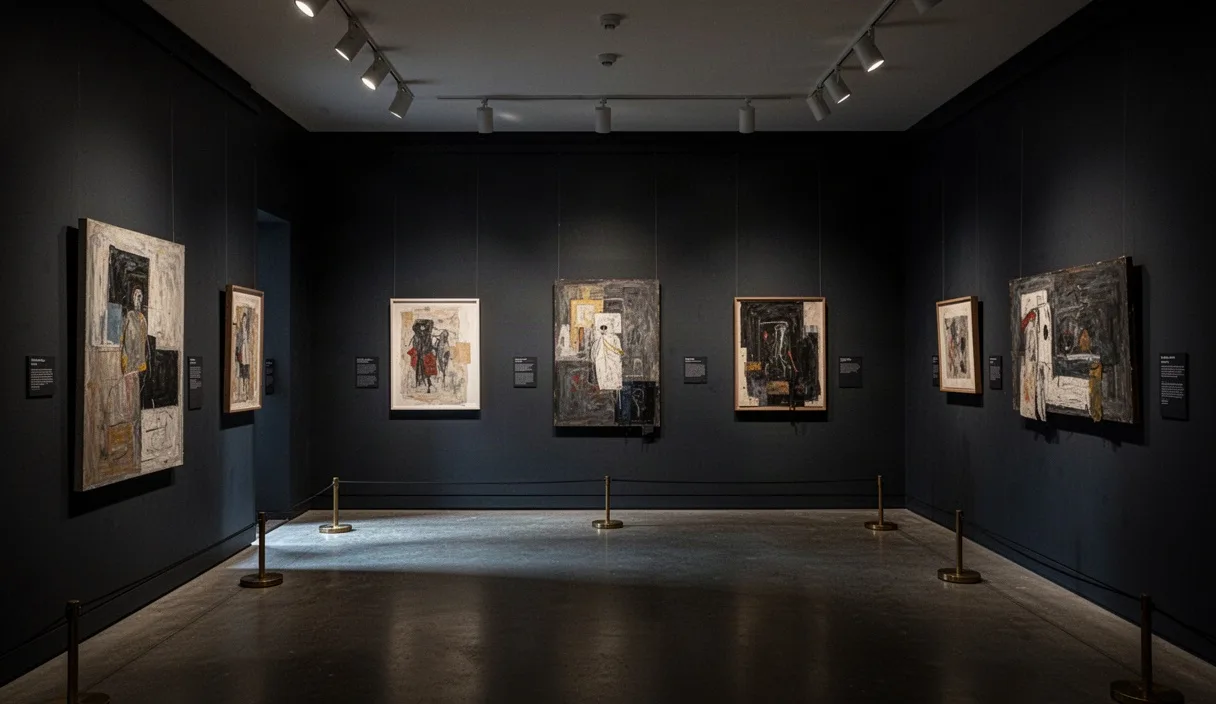

As machine-generated imagery continues its migration from screens and servers into galleries and museum halls, institutions face a question that no algorithm can settle on its own: what belongs on the wall, and why. The arrival of generative tools has not removed the need for discernment; if anything, it has sharpened the demand for it. A curator's task has never been simply to display what is technically impressive, but to decide what deserves sustained attention, context and comparison against the broader history of art.
This article considers how curatorial judgment operates when AI-generated or AI-assisted works enter an exhibition programme. It examines what professionals look for beyond the mechanics of the tools involved, how such works are placed within a larger narrative, and where institutions commonly stumble. The aim is not to settle the debate over whether AI art belongs in museums, a question already being asked at venues from the Victoria and Albert Museum to smaller regional galleries, but to clarify what responsible curatorial practice looks like in this still-forming field.
What Curators Look for Beyond the Technology
A common misconception holds that curating AI art is primarily a technical exercise, a matter of understanding diffusion models, GANs or the particular dataset an artist trained on. In practice, experienced curators treat the underlying technology much as they would treat a painter's choice of pigment or a sculptor's choice of bronze: relevant background, not the main criterion for inclusion. The central questions remain the same ones applied to any submitted work. Does the piece demonstrate a coherent visual or conceptual intention? Does it reward repeated viewing? Does it contribute something that other works in the show do not already provide?
Curators at institutions such as the Barbican and the Centre Pompidou have noted, in public talks and exhibition catalogues, that they ask artists working with AI tools to articulate their process in plain terms: what prompts or training data were used, how many iterations were generated before a final selection, and what role human editing played after generation. This is not bureaucratic box-ticking. It allows the curator to assess the degree of authorial intention, which in turn affects how the work is framed in wall text and catalogue essays.
Several practical markers tend to guide this assessment:
- Evidence of iterative refinement rather than a single unedited output, which suggests sustained engagement with the material.
- A stated rationale connecting the artist's broader practice to the specific use of AI tools, rather than novelty for its own sake.
- Material presentation choices, such as print quality, scale and framing, that indicate deliberate curatorial and artistic decisions beyond the digital file.
- Consistency with a body of work, allowing a viewer to trace development across multiple pieces rather than encountering an isolated curiosity.
None of these criteria differ substantially from what a curator would apply to photography when it was first exhibited in fine art contexts during the nineteenth century, or to video art in the 1960s and 1970s. The tool changes; the underlying questions about intention, consistency and craft persist.
Placing AI Works Within a Broader Exhibition Narrative
An AI-generated piece displayed in isolation risks being read as a technological demonstration rather than an artistic statement. Thoughtful curators therefore place such works in dialogue with pieces made through other means, allowing visitors to draw their own comparisons rather than being told what to conclude. A 2023 exhibition at the Serpentine, for instance, situated AI-assisted pieces alongside drawings and archival material documenting the artist's earlier analogue practice, making the technological shift legible as part of a continuous creative trajectory rather than a rupture.
This contextual placement often extends to historical framing. Some institutions have paired contemporary AI works with early computer art from the 1960s, such as pieces by Vera Molnár or Frieder Nake, to demonstrate that artists have engaged with algorithmic processes for over six decades. This lineage matters because it counters the assumption that AI art is a wholly novel phenomenon requiring entirely new evaluative frameworks. It is new in degree, not always in kind.
Wall text and catalogue essays carry particular weight in these exhibitions. A curator must decide how much technical explanation to offer without turning the gallery into a classroom on machine learning. The better examples keep technical notes concise, typically no more than two or three sentences per work, while reserving fuller discussion for an accompanying booklet or digital guide that interested visitors can seek out voluntarily.
Sequencing within the physical space also matters. Placing AI-assisted works near the entrance, as a kind of novelty hook, tends to flatten the viewer's later engagement with more traditional media in the same show. Several curators interviewed for exhibition reviews have instead favoured integrating such works throughout the space, interspersed by theme or medium rather than segregated into a dedicated "AI room," which can inadvertently suggest the work does not belong among its peers.
Balancing Novelty Against Lasting Artistic Value
Exhibition programming operates under real commercial and institutional pressure. A show featuring AI-generated imagery can draw press attention and ticket sales simply by virtue of the subject's topicality. This creates a tension that curators must manage deliberately: the short-term appeal of novelty versus a work's capacity to hold interest once the technological conversation has moved on.
One useful exercise, described by several gallery directors in trade publications, involves imagining a piece exhibited without any mention of its method of production. Would it still merit a place in the show based on composition, colour, conceptual depth or emotional resonance alone? If the answer is uncertain, the work's inclusion may rest too heavily on topical interest rather than lasting artistic merit.
The following comparison illustrates two contrasting curatorial approaches often seen in recent programming:
| Approach | Typical Focus | Risk |
|---|---|---|
| Novelty-driven selection | Highlighting the use of AI tools as the central draw | Work ages poorly once the technology becomes commonplace |
| Practice-driven selection | Evaluating the artist's full body of work, with AI as one method among several | May require more research time and fewer immediate press hooks |
Institutions with longer-term collecting mandates, such as permanent collection museums rather than temporary commercial galleries, tend to favour the practice-driven approach, since they must consider how a work will read in twenty or thirty years, not merely at the opening reception. A piece selected purely for its topicality in 2024 may require significant recontextualization by 2034, a cost that acquisitions committees are increasingly factoring into their deliberations.
Common Curatorial Pitfalls With AI-Related Shows
Several recurring mistakes appear across recent AI art programming, many of them avoidable with closer attention during the planning stages.
- Treating the technology as the exhibition's thesis. A show organized around the premise "look what AI can do" tends to date quickly and offers limited critical framework for visitors to evaluate individual works on their own merits.
- Insufficient disclosure of process. Visitors increasingly expect clarity about how much human intervention shaped a given piece. Vague wall text that avoids specifics can read as evasive rather than tasteful.
- Overcrowding with similar outputs. Because generative tools can produce large volumes of imagery quickly, some shows include too many visually similar pieces, diluting the impact of the strongest examples. A tighter selection of twelve to fifteen pieces often serves the material better than forty.
- Ignoring provenance and training data questions. Legal and ethical scrutiny around training datasets continues to evolve, and curators who fail to address these questions, even briefly, risk appearing uninformed when journalists or visitors raise them. Institutions uncertain about copyright exposure in this area should consult legal counsel familiar with intellectual property law rather than relying on informal assumptions.
- Underestimating conservation and reproducibility questions. Digital files generated through proprietary tools may become difficult to reproduce or authenticate years later if the originating software changes or is discontinued. Registrars and conservators are only beginning to develop standard practices here.
Questions Visitors Can Ask While Viewing
Visitors without specialist training in either art history or machine learning can still engage critically with AI-related exhibitions by asking a small set of grounded questions while moving through the space.
- What is stated about the artist's process, and does the wall text specify the degree of human editing involved after initial generation?
- Does this piece connect to a broader body of work by the same artist, or does it appear as an isolated experiment?
- Would this work hold my attention if I did not know how it was made?
- How does the physical presentation, printing, scale, framing, add or detract from the piece, beyond the digital image itself?
- Does the exhibition address, even briefly, questions of training data and consent where relevant to the artist's stated method?
Visitors who want deeper engagement can also ask gallery staff directly whether the institution has a published policy on AI-related acquisitions or exhibitions, since a growing number of museums, including several within the Smithsonian network, have begun drafting internal guidelines on this subject. Staff familiarity with such policies, or lack of one, often signals how seriously an institution has thought through the issues at stake.
For those considering deeper involvement, whether as collectors, students or simply engaged members of the public, a sensible next step is attending curator-led walkthroughs when offered, since these sessions typically surface the reasoning behind specific placement and selection decisions that wall text alone cannot convey. Readers researching acquisition or valuation questions involving AI-related works should consult a qualified art advisor or appraiser, as these remain unsettled areas where professional guidance matters more than general reading. Exhibition catalogues from institutions with established track records in this space, including the aforementioned Serpentine and Barbican programmes, remain a useful starting point for building a more informed eye before the next show opens.