 Ochre & Circuit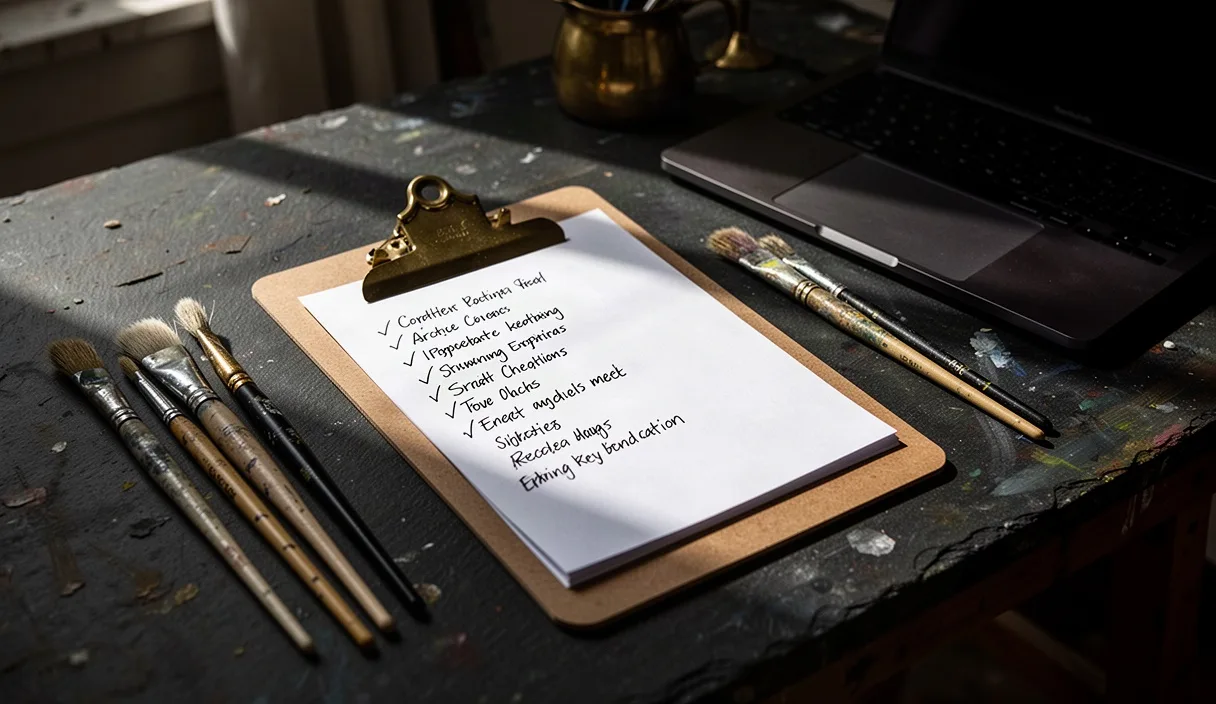
Artificial intelligence now assists a considerable portion of the work submitted to galleries, print competitions, and online marketplaces, and the question of how to describe that assistance has moved from a matter of personal preference to one of professional courtesy. A collector, juror, or publisher who later discovers an undisclosed AI contribution does not merely feel misled about a technical detail; the omission colours their trust in everything else the artist has told them. This article offers a working checklist for deciding what to disclose, where disclosure is expected, and how to phrase it without sounding apologetic or evasive.
The guidance below is intended as a studio practice reference, not as legal counsel. Institutions and competitions vary in their requirements, and an artist with contractual or copyright concerns should consult a solicitor familiar with intellectual property before signing agreements or entering major prizes.
Why Disclosure Has Become a Professional Expectation
Several major competitions, including the Sony World Photography Awards, have disqualified entrants after AI involvement came to light post-judging, a consequence more damaging to reputation than any initial rejection would have been. Juries have made clear that the issue at stake is rarely the use of the tool itself but the absence of a stated process. Once a work is exhibited or sold without that context, correcting the record afterward is far harder than including it at the outset.
Buyers and curators have also grown more literate about generative tools over the past two or three years, which means the question "was this made with AI" is asked more often and answered less politely when it was avoided rather than addressed. An artist who volunteers the information controls the framing; one who is asked directly, after the fact, loses that control entirely.
There is a quieter professional reason as well: disclosure protects the artist's own record-keeping. A studio that notes which works involved a diffusion model, which used AI only for reference generation, and which were entirely hand-produced will have a far easier time responding to licensing questions, print requests, or gallery due diligence a year or two later, when memory alone is unreliable.
What to Disclose: Tools, Data, and Human Input
A useful disclosure answers three separate questions, and conflating them is the most common source of confusion. First, which software or model was used. Second, where the underlying training data or reference material came from, to the extent the artist knows or can reasonably describe it. Third, what proportion of the final work reflects human decision-making versus machine output.
- Tool and version: naming the specific software, for example Midjourney v6, Adobe Firefly, Stable Diffusion with a named checkpoint, or a custom-trained LoRA, rather than the generic term "AI," gives a reader something concrete to evaluate.
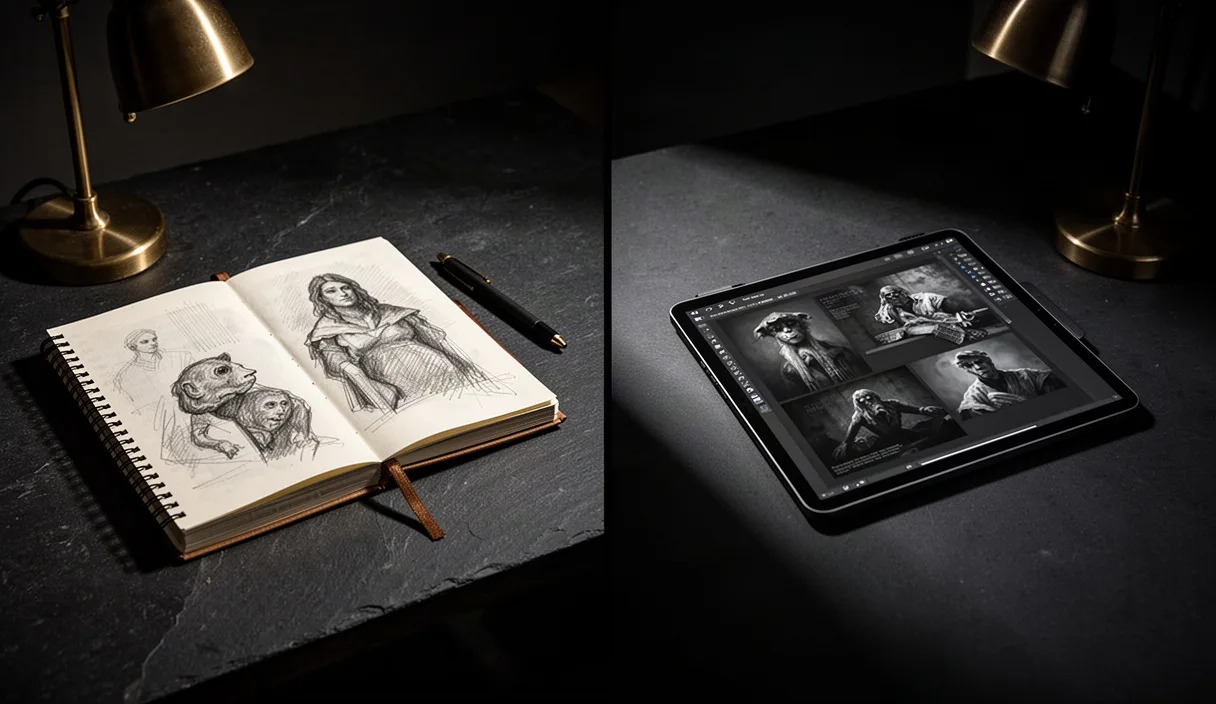
- Role of the tool in the workflow: was it used for initial composition sketches that were then painted over by hand, for upscaling a hand-drawn piece, for generating texture elements later composited in, or for producing the final image wholesale with light retouching.
- Human contribution: describing the artist's own input in hours or stages, such as twelve hours of manual painting over a generated base, or three months of prompt refinement and selection from several hundred generations, gives a sense of proportion that the word "assisted" alone does not convey.
- Data provenance, where known: if a custom model was trained on the artist's own archive of photographs or drawings, saying so distinguishes that practice from use of a general-purpose public model trained on undisclosed sources.
An artist who used an AI upscaler solely to prepare a hand-drawn piece for large-format print is in a materially different position from one who generated a finished composition from a text prompt, and the disclosure should make that distinction legible rather than lumping both under a single disclaimer.
Where Disclosure Is Required and Where It Is Optional
Requirements differ sharply by venue, and an artist exhibiting across several contexts in a given year should expect to adjust the wording and depth of disclosure for each one rather than reusing a single boilerplate line.
| Context | Typical expectation | Notes |
|---|---|---|
| Photography competitions (e.g. major international awards) | Mandatory, often a separate entry category | Misclassification has led to disqualification after the fact in several documented cases. |
| Gallery representation agreements | Frequently requested in writing | Some galleries now include an AI-use clause in consignment contracts; read these carefully. |
| Print-on-demand and stock platforms | Often mandatory via platform policy | Several major stock agencies restrict or flag AI-generated submissions separately from human-made work. |
| Personal website or portfolio | Optional but increasingly expected | A short process note builds trust even where no rule compels it. |
| Social media posts | Optional, platform-dependent | Some platforms now apply automatic AI labels; a caption-level note avoids relying solely on that detection. |
| Fine art auctions and private sales | Expected by most reputable houses | Nondisclosure discovered after sale can affect provenance value and buyer trust. |
Where disclosure is not formally required, an artist still benefits from a brief, consistent note in their portfolio or artist statement, since the absence of any mention, once AI use becomes common knowledge in a field, begins to read as concealment even when none was intended.
Wording That Is Honest Without Being Defensive
The tone of a disclosure matters almost as much as its content. A statement that reads as an apology ("I'm sorry to say this piece used AI") invites suspicion, while one that reads as a dry technical footnote ("Generated using Midjourney") can feel evasive about the artist's own contribution. The more useful register sits between the two: plain, specific, and unhurried.
Consider three versions of a disclosure for the same piece:
- Too vague: "Some AI involved."
- Too defensive: "I know some people have strong feelings about this, but I used a bit of AI assistance, please don't judge too harshly."
- Workable: "Composition generated with Midjourney v6 from an original prompt, then reworked by hand in oil over roughly eighteen hours, including repainting the figure and altering the palette throughout."
The workable version succeeds because it names the tool, states the human labour in concrete terms, and does not ask the reader for forgiveness or approval. It treats the disclosure as a factual caption rather than a confession, which is the register most galleries and competitions expect of provenance information generally, whether the subject is AI, collage sources, or studio assistants' contributions to a large sculpture.
A Reusable Checklist Template
The following template can be adapted to a wall label, a website caption, or a competition entry form. Not every field will apply to every piece, and a short piece may only need the first three lines.
- Tool(s) and version used, named specifically.
- Stage of the workflow where the tool was applied (concept, composition, texture, upscaling, colour correction).
- Estimated proportion of the final work attributable to human hand versus machine output, in hours or percentage of surface area where relevant.
- Source or provenance of any training data, if a custom or fine-tuned model was used.
- Date the disclosure was written, since tool capabilities and studio practice both change.
- Venue-specific requirements checked (competition rules, gallery contract clause, platform policy) before submission.
Keeping a dated log of these entries, even a simple spreadsheet with one row per artwork, saves considerable time when the same piece is later submitted to a different venue with different disclosure rules.
Common Mistakes
Artists most often err in one of three directions: omitting disclosure entirely in the belief that light AI assistance does not count, using a vague catch-all phrase that satisfies no one's actual question, or disclosing so apologetically that the statement undermines confidence in the work itself. A fourth, quieter mistake is inconsistency, disclosing fully on a competition form but leaving the same piece unmarked on a personal website, which creates exactly the kind of discrepancy that erodes trust when a juror or collector happens to compare the two.
Next Steps
An artist preparing new work should decide on a disclosure habit before the next submission deadline rather than improvising language under time pressure. Drafting a one-paragraph studio statement describing general AI practice, then adjusting it per piece as needed, is faster than writing from scratch each time and reduces the risk of inconsistent wording across venues. Where a contract or competition's rules on AI use are unclear, writing to the organiser for clarification before entering is a reasonable and ordinary request, and where the matter involves copyright or licensing exposure, a brief consultation with an intellectual property solicitor is a sound precaution rather than an overreaction.